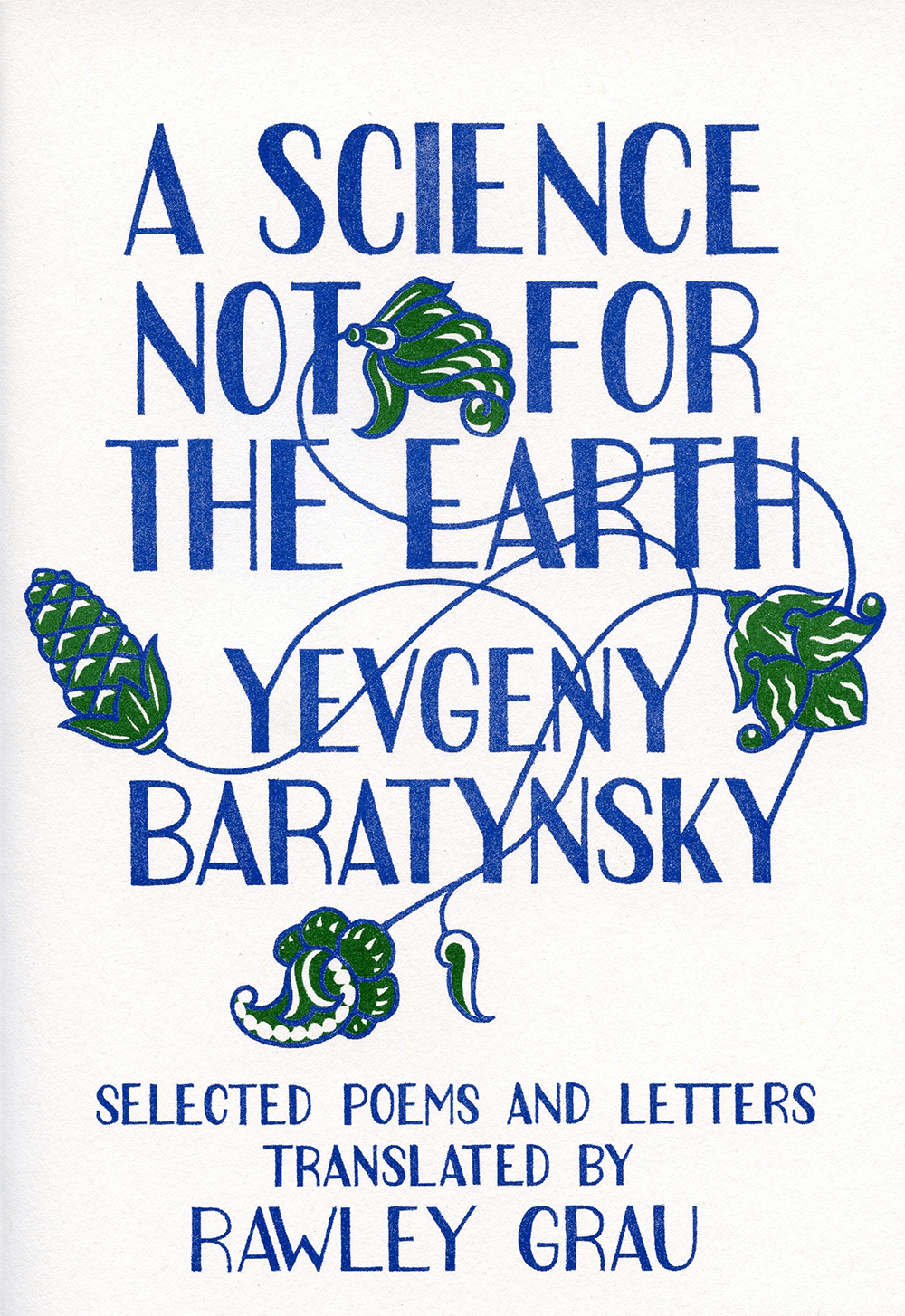
Featuring some 75 poems, from the early elegies to poems from his final years, Baratynsky’s A Science Not for the Earth is the first representative collection of the poet’s lyric verse in English translation. A selection of Baratynsky’s letters, reflecting his critical thoughts on writing as well as his personal struggles, is also included.
Baratynsky was lauded by Alexander Pushkin as the finest Russian elegiac poet. After a long period of neglect, Baratynsky was taken up by Russian Modernists who considered him a supreme poet of thought. This “most daring and dark of the nineteenth-century poets,” as Michael Wachtel has called him, inspired Anna Akhmatova and Osip Mandelstam, and later, according to the Nobel laureate himself, forced a young Joseph Brodsky “to get more seriously into writing.”
It is only in the past quarter-century or so that Yevgeny Abramovich Baratynsky (1800–1844) has gained wide recognition in Russia as one of the great poets of the 19th century. While the psychologically acute love elegies and meditations he wrote in the early 1820s earned him some fame during his lifetime, his later lyric verse was ignored or misunderstood by most of his contemporaries. Yet it is this body of work in particular, where he explores fundamental questions about the meaning of existence from an analytical epistemological perspective, that today seems remarkably modern.
The poet’s radical skepticism, as well as his increasing sense of isolation from the literary world, is reflected most profoundly in his lyric masterpiece, the book Dusk (Sumerki, 1842) — translated in its entirety in this volume — a work that is notable, among other things, for being the first collection of poems published in Russia as a coherent literary cycle (a practice that would become standard only 60 years later).
The book is guest-edited by Russian-American poet Ilya Bernstein.
Winner of the 2016 AATSEEL Award for Best Scholarly Translation into English.
Featuring some 75 poems, from the early elegies to poems from his final years, Baratynsky’s A Science Not for the Earth is the first representative collection of the poet’s lyric verse in English translation. A selection of Baratynsky’s letters, reflecting his critical thoughts on writing as well as his personal struggles, is also included.
Baratynsky was lauded by Alexander Pushkin as the finest Russian elegiac poet. After a long period of neglect, Baratynsky was taken up by Russian Modernists who considered him a supreme poet of thought. This “most daring and dark of the nineteenth-century poets,” as Michael Wachtel has called him, inspired Anna Akhmatova and Osip Mandelstam, and later, according to the Nobel laureate himself, forced a young Joseph Brodsky “to get more seriously into writing.”
It is only in the past quarter-century or so that Yevgeny Abramovich Baratynsky (1800–1844) has gained wide recognition in Russia as one of the great poets of the 19th century. While the psychologically acute love elegies and meditations he wrote in the early 1820s earned him some fame during his lifetime, his later lyric verse was ignored or misunderstood by most of his contemporaries. Yet it is this body of work in particular, where he explores fundamental questions about the meaning of existence from an analytical epistemological perspective, that today seems remarkably modern.
The poet’s radical skepticism, as well as his increasing sense of isolation from the literary world, is reflected most profoundly in his lyric masterpiece, the book Dusk (Sumerki, 1842) — translated in its entirety in this volume — a work that is notable, among other things, for being the first collection of poems published in Russia as a coherent literary cycle (a practice that would become standard only 60 years later).
The book is guest-edited by Russian-American poet Ilya Bernstein.
Winner of the 2016 AATSEEL Award for Best Scholarly Translation into English.