Book 2024

Poeticheskie teksty RU

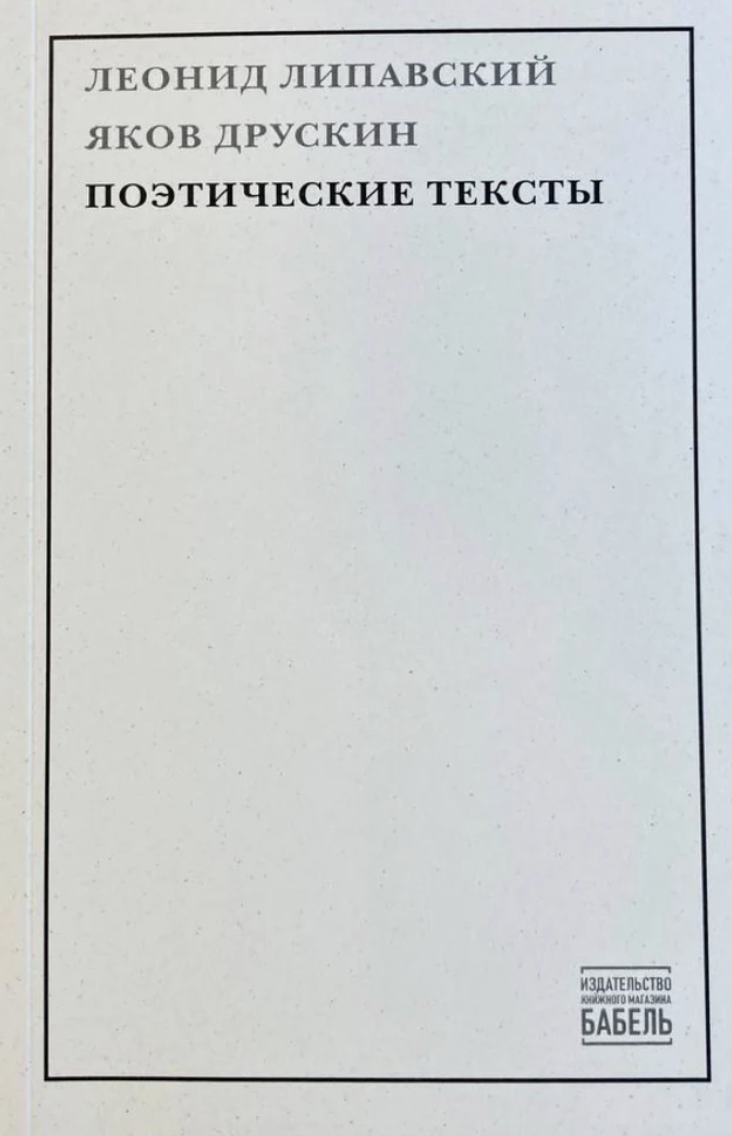
Поэтические тексты
Poeticheskie teksty Поэтические тексты
Information
Realm
Russian
Author
Yakov Druskin
Leonid Lipavsky
Title
Poeticheskie teksty
Paratexts

Preface by: Valery Shubinsky

Place of Publication
Tel Aviv
Publisher
Babel Books Tel Aviv
Date of Publication
2024
Material Type
Book
Format
Paperback
Number of Pages
79
OCLC Number
1535655701
ISBN
9789659320486
Language
Russian
Genre
Poetry
Yakov Druskin, Leonid Lipavsky. Poeticheskie teksty. Tel Aviv: Babel Books Tel Aviv, 2024.
Description

Леонид Савельевич Липавский и Яков Семёнович Друскин, если коротко, — это два философа, близкие к ОБЭРИУ. Первый написал несколько прекрасных текстов, в том числе «Исследование ужаса», а ещё в 1933-1934 годах зафиксировал и сохранил «Разговоры», которые вели между собой Хармс, Введенский, Олейников, Заболоцкий, Друскин и сам Липавский. Пропал без вести на Ленинградском фронте с 22 сентября 1941 года. Второй оставил после себя дневники, которые вёл с 1926-го по 1966 год, и философские труды, а блокадной зимой 1941-го на детских саночках отвёз с улицы Маяковского на Петроградскую сторону архив арестованного Хармса, сохранил его — и оказавшиеся у него позже сохранившиеся рукописи Введенского — и в 1960-е допустил к ним некоторых литературоведов. Дожил до начала 1980 года. Оба не мнили себя поэтами, но оставили некоторое количество поэтических текстов. Именно их мы и издали — благодаря литературоведу Валерию Шубинскому. 

Leonid Savelievich Lipavsky and Yakov Semyonovich Druskin were two philosophers closely associated with the avant-garde artist collective OBERIU. The former wrote several excellent texts, including An Investigation of Horror, and in 1933–1934 recorded and preserved the Conversations between Kharms, Vvedensky, Oleinikov, Zabolotsky, Druskin, and Lipavsky himself. He went missing in action on the Leningrad Front on September 22, 1941. The latter left behind diaries he kept from 1926 to 1966, as well as philosophical works. During the siege winter of 1941, he transported the archives of the arrested Kharms from Mayakovsky Street to the Petrograd Side on a children’s sled, preserved them—along with Vvedensky’s manuscripts that later came into his possession—and in the 1960s made them available to certain literary scholars. He lived until the early 1980s. Neither Lipavsky nor Druskin considered themselves poets, but they left behind a number of poetic texts. It is these that we have published—thanks to literary scholar Valery Shubinsky.