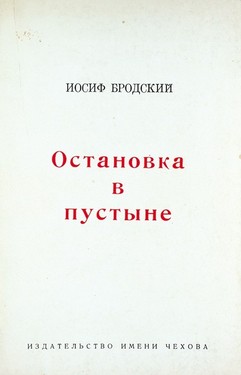
However much Brodskij has learned from Western poets such as John Donne and T.S. Eliot, his verse stems primarily from Russian poetry of the generation of Axmatova and Pasternak. He shares with poets of that era their ability to create serious poetry out of seemingly inconsequential material and their high regard for craftsmanship (“Ja zaražen normal’nym klassicizmom”). He has a thoroughly contemporary voice: he is distrustful of metaphysics, concerned with cultural values, and nostalgic for human warmth. He has a low-key style and a wariness of solemnity. These traits could already be seen in the earlier collection Stixotvorenija i poèmy (1965). The present book contains some selections from the earlier one and new lyrics and long poems written up to 1969.
The book is divided into six sections, the first of which, “Xolmy,” consists in poems written before his arrest in 1963. These are more often generalizing than private in subject; they are reflections on the human condition, cultural circumstances, metaphysics, and art. Of the long poems, “Xolmy” reminds one of the omnipresence of death in life, “Bol'šaja èlegija: Džonu Donnu” ties the spiritual to the flesh, and “Isaak i Avraam” treats the heritage of sacrifice and yearning for salvation. About life he is skeptical, sad, and ironic (“Kak budto žizn' kačnetsja vpravo, / kačnuvšis’ vlevo”). He avoids direct and unambiguous statements. Instead, he tends to the metaphorical and to the simple depiction of imagery. Thus we see the scenes of his reflections – the streets of Leningrad and Moscow, rooms and furniture, rural areas. Occasionally his imagery is allegorical (galloping horsemen) or mythical (Ajax).
Most of the lyrics concerned with love are gathered into the second section, “Anno Domini,” and autobiography comes to the fore. In early poems he records a happy passion in domestic and seaside settings. The title poem is the inner monologue of a banished author in a medieval setting; his dispassionateness is good (“Začem kuda-to rvat’sja iz dvorca – /otčizne my ne sud'i”). The later poems reflect a painful separation and sense of loss; one depicts Dido as she watches the retreating Aeneas. His latest poem is called “Proščajte, madmuazel’ Veronika.”
Lyrics written since his arrest comprise the third section, “Fontan.” Private circumstances are more prevalent than among the earlier lyrics. First, we are plunged into the bleak northern countryside which represents his internment. He takes a real interest in these forests and marshlands, and his sadness and unexpected joys are moods, not existential conditions. The same lonely landscape is seen in the long poem, “Novye stansy k Avguste,” where his desperation is apparent (“I smex moj kriv”), and his consolation is in lyrical inspiration. “Pis’mo v butylke,” a long poem purporting to be the tale of a shipwreck, seems to be a hyperbolic metaphor on his detainment and “sinking” feelings; the poem is a farewell to a love. The lyrics written since his release include a cycle, “Iz Škol’noj antologii” relating the biographies of several former schoolmates, men and women. This is a world of blue-collar jobs, shops, and restaurants; the lives depicted are thwarted but not unusual. Each poem is self-sufficient; combined they hint at a biography of the author. The title poem “Fontan” suggests that we are tied to our unique past through the loneliness of possessing it.
The broader statements are usually among the poèmy. He associates art with spiritual value. In his tribute to Eliot, “Stixi na smert’ T. S. Èliota,” he applauds the love for the world that he finds in his verse. On the other hand, “Dva časa v rezervuare” is a debunking of the Faust legend, whose metaphysics he finds self-seeking and too comfortable. He is concerned with the potentials of culture. In “Einem alten Architekten in Rom” he brings home the human capacity for mass destruction by showing the ruins of Königsberg after World War II. The poèma “Ostanovka v pustyne” is a comment on the razing of a Greek church in Leningrad; he concludes that each era has a common duty and owes a sacrifice (“I čto dolžny my prinesti ej v žertvu?”). The concluding story, “Gorbunov i Gorbačev [sic!],” shows through its portraits of two patients in a mental institution that suffering comes not only from within: it can be inflicted by other people and by enforced detention. Ultimately, the subject is the human need for compassion, love, closeness (“Spi, spi, moj drug. Ja posižu s toboj.”).
Stylistically he shares some traits with the avant-gardists. He tends to a longish form, even in lyrics. His conversational mode is lively, intellectual, and full of surprises. He can rise to eloquence; he uses colloquial forms, even scientific terms (kompleks Narcissa). The spoken quality of his verse often becomes overt in addresses, inner monologues, dialogues (the whole of “Gorbunov i Gorbačev”). Tropes are common, especially metaphors, and can be extended (a bird for his creative soul). Wit and humor appear often, and in some poems wordplays. Sound similarities are allowed to create false associations (vina-vino, sud-sudo). There are other special linguistic effects; the whole of “Dva časa v rezervuare” is macaronic, spelling German in Cyrillic letters. A number of poems seem to end with a pointe – perhaps a new perspective, even a contradiction (“pojmat' sebja v slovax neotkrovennyx”).
The formality that he avoids in his language he cultivates in his prosody, which is basically Classical; his favorite meter is iambic pentameter. But variety and experimentation are not absent. Free verse appears occasionally, and also blank verse (all the sonnets). In the later poems he shows an interest in specially invented rhyme schemes.
The book is introduced by a brief biography. An introductory article, signed N.N., offers a characterization of Brodskij’s verse and an account of his poetic interests.
Evelyn Bristol
University of Illinois at Urbana-Champaign
"