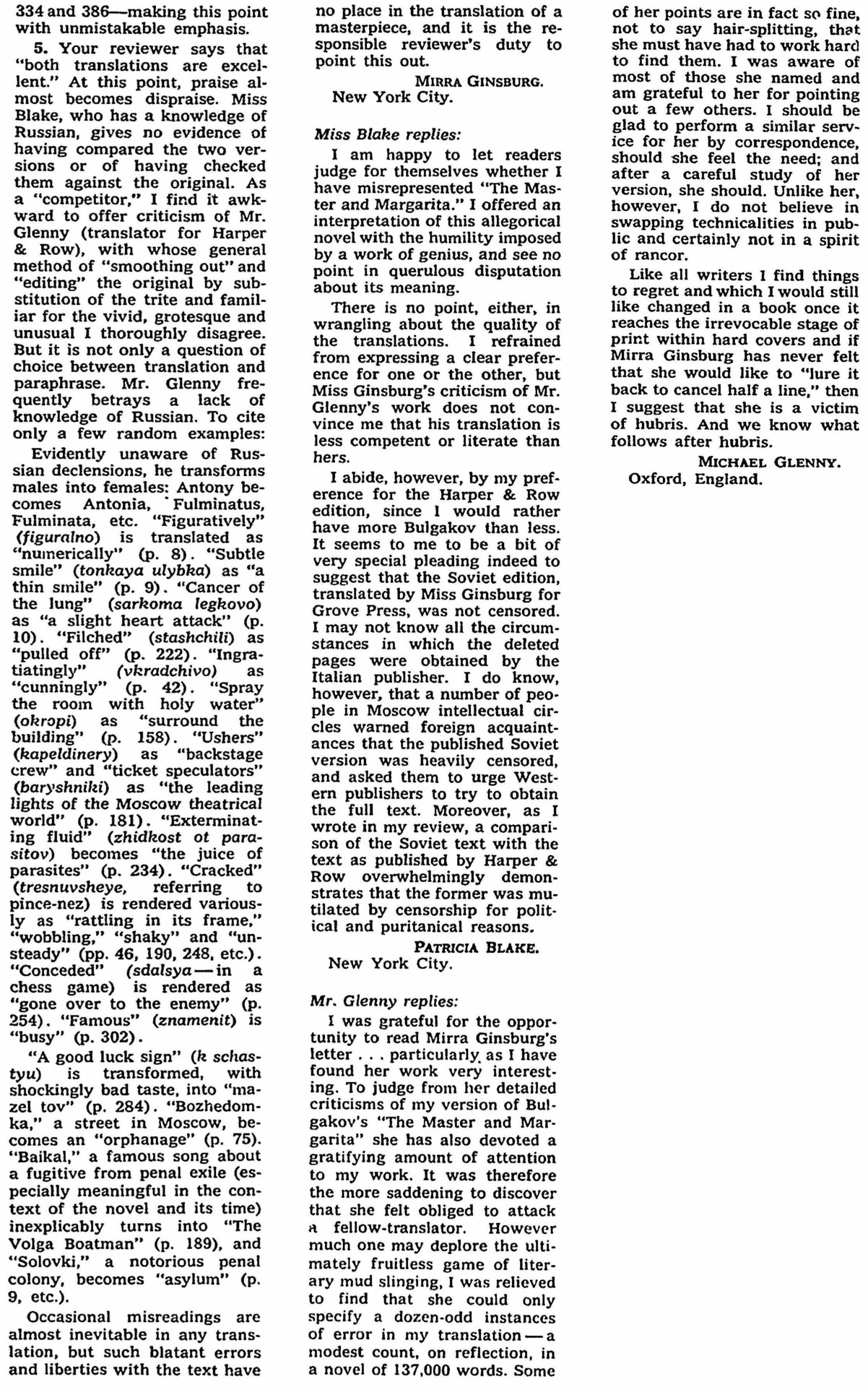

The New York Times (January 14, 1968). Text prepared by Ekaterina Ialovkina.
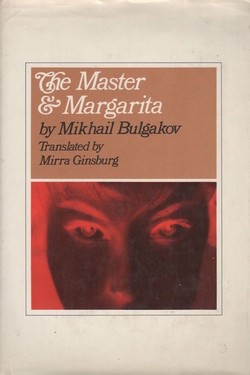
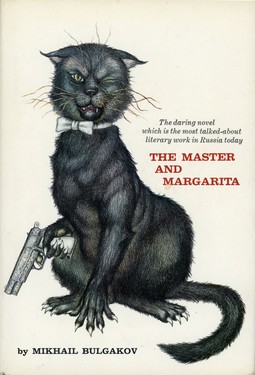
In a review (Oct<ober> 22, 1967) of “The Master and Margarita” by Mikhail Bulgakov, Patricia Blake wrote that “Two editions of ‘The Master and Margarita’ have been published in America. But how unfortunate that of these two, only one has been translated (by Michael Glenny for Harper & Row) from the text as it was written by Bulgakov, which was obtained from unofficial sources in Russia. The other translation (by Mirra Ginsburg for Grove Press) was made from the expurgated text published in Russia last year.” Miss Blake made an analysis of the Soviet-Grove Press version and concluded that “the whole atmosphere of repression” of the 1930’s “has been shaded out by the censor,” and that “the sense of the novel has been lost.”
To the Editor:
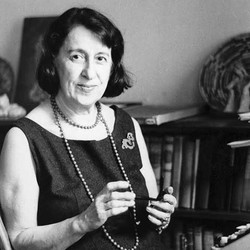
As translator of the Grove Press edition of “The Master and Margarita,” by Mikhail Bulgakov, I find myself, much against my will, at the center of a controversy which I feel needs clarification. I am grateful to Patricia Blake, for praising my translation. I must however, question some of her rather surprising misstatements.
1. Nowhere in Bulgakov’s novel is the Master “packed off to a lunatic asylum.” He seeks it out himself. Nowhere does the Master make or break any “bargain with the devil,” whether for “youth, love, knowledge” – or freedom. Nowhere does the Master “confront and deal with” the devil, and nowhere is the devil compelled to “yield to forces stronger than he.” Nowhere does the Master “settle <…> for the devil’s offer of limbo in a cozy cottage.” (He is assigned to this “eternal refuge” – in a supremely ironic passage – at the request of Jesus.) And nowhere is the artist shown as a “redeeming figure.”
Bulgakov was quite alien to such clichés, and his conception is much more profound and original. In this grand comic novel, both Jesus and the Master appear as completely passive figures, important for what they are, not what they do (in itself a revolutionary idea in Soviet Russia). Both are “done to,” and neither takes action to oppose his fate. Clearly, Bulgakov’s concern goes far beyond topical politics, important as those were to him both as individual and writer.
2. Miss Blake says that Bulgakov’s novel was completed in 1938, and that the Harper edition has the “complete text.” Konstantin Simonov, who heads the Commission on Bulgakov’s Literary Heritage, wrote that Bulgakov worked on the novel from 1928 until his death in 1940, creating different versions and dictating revisions even during his final illness. Certain inconsistencies in the text clearly indicate that it was still a work in progress and that Bulgakov had not yet come to a final decision as to the treatment of some of its themes and incidents. Bulgakov’s archives surely contain hundreds of pages not included in either version, and neither can be regarded as “complete,” since Bulgakov did not live to finish the book.
3. Your reviewer writes that the material added to the Harper version “was obtained from unofficial sources.” According to the editors of Harper & Row, this material was obtained from the Italian publisher Einaudi. And a spokesman for Einaudi states that it came from Mrs. Bulgakov, “with the approval” of the Commission on Bulgakov’s Literary Heritage. Could anyone seriously believe that this commission would supply a foreign publisher with material “censored” and “expunged” for political or moral reasons? Obviously, this material was not considered “sensitive” by its quite official Soviet source. Hence, such designations as “censored,” “expurgated” and “unexpurgated” are entirely beside the point.
4. Your reviewer lists the topics of the deleted passages but neglects to mention that those topics run through the entire book. The reader will find all women quite naked throughout Chapters 14, 20, 21, 23, 24, etc. For lechery, see Chapters 7, 12, 21; for housing shortages, see Chapters 18, 19, 24: for foreign currency, hoarding, greed and speculation, see Chapters 9, 12, 18, 24 – and so on.
Another misstatement is that the theme of Pilate’s guilt through cowardice is omitted from the Grove version, so that “the sense of the novel has been lost.” May I commend Miss Blake to Chapter 2, in which Pilate confirms the sentence of the Sanhedrin for fear of Caesar, and bluntly says to Jesus: “Do you think I am prepared to take you place?” and Chapter 26, “Can you <…> suppose that the Procurator of Judea would ruin his career over a man who had committed a crime against Caesar?” The explicit condemnation of cowardice as “one of the most terrible” or “the most terrible” vice is also to be found on pp. 334 and 386 – making this point with unmistakable emphasis.
5. Your review says that “both translations are excellent.” At this point, praise almost becomes dispraise. Miss Blake, who has a knowledge of Russian, gives no evidence of having compared the two versions or of having checked them against the original. As a “competitor,” I find it awkward to offer criticism of Mr. Glenny (translator for Harper & Row), with whose general method of “smoothing out” and “editing” the original by substitution of the trite and familiar for the vivid, grotesque and unusual I thoroughly disagree. But it is not only a question of choice between translation and paraphrase. Mr. Glenny frequently betrays a lack of knowledge of Russian. To cite only a few random examples:
Evidently unaware of Russian declensions, he transforms males into females: Antony becomes Antonia, Fulminatus, Fulminata, etc. “Figuratively” (figuralno) is translated as “numerically” (p. 8). “Subtle smile” (tonkaya ulybka) as “a thin smile” (p. 9). “Cancer of the lung” (sarkoma legkovo) as “a slight heart attack” (p. 10). “Filched” (stashchili) as “pulled off” (p. 222). “Ingratiatingly” (vkradchivo) as “cunningly” (p. 42). “Spray the room with holy water” (okropi) as “surround the building” (p. 158). “Ushers” (kapeldinery) as “backstage crew” and “ticket speculators” (baryshniki) as “the leading lights of the Moscow theatrical world” (p. 181). “Exterminating fluid” (zhidkost ot parasitov) becomes “the juice of parasites” (p. 234). “Cracked” (tresnuvsheye, referring to pince-nez) is rendered variously as “rattling in its frame,” “wobbling,” “shaky,” and “unsteady” (pp. 46, 190, 148, etc.). “Conceded” (sdalsya – in a chess game) is rendered as “gone over to the enemy” (p. 254). “Famous” (znamenit) is “busy” (p. 302).
“A good luck sign” (k schastyu) is transformed, with shockingly bad taste, into “mazel tov” (p. 284).
“Bozhedomka,” a street in Moscow, becomes an “orphanage” (p. 75). “Baikal,” a famous song about a fugitive from penal exile (especially meaningful in the context of the novel and its time) inexplicably turns into “The Volga Boatman” (p. 189), and “Solovki,” a notorious penal colony, becomes “asylum” (p. 9, etc.).
Occasional misreadings are almost inevitable in any translation, but such blatant errors and liberties with the text have no place in the translation of a masterpiece, and it is the responsible reviewer’s duty to point this out.
Mirra Ginsburg
New York City
Miss Blake replies:
I am happy to let readers judge for themselves whether I have misrepresented “The Master and Margarita.” I offered an interpretation of this allegorical novel with the humility imposed by a work of genius, and see no point in querulous disputation about its meaning.
There is no point, either, in wrangling about the quality of the translations. I refrained from expressing a clear preference for one or the other, but Miss Ginsburg’s criticism of Mr. Glenny’s work does not convince me that his translation is less competent or literate than hers.
I abide, however, by my preference for the Harper & Row edition, since I would rather have more Bulgakov than less. It seems to me to be a bit of very special pleading indeed to suggest that the Soviet edition, translated by Miss Ginsburg for Grove Press, was not censored. I may not know all the circumstances in which the deleted pages were obtained by the Italian publisher. I do know, however, that a number of people in Moscow intellectual circles warned foreign acquaintances that the published Soviet version was heavily censored, and asked them to urge Western publishers to try to obtain the full text. Moreover, as I wrote in my review, a comparison of the Soviet text with the text published by Harper & Row overwhelmingly demonstrates that the former was mutilated by censorship for political and puritanical reasons.
Patricia Blake
New York City
Mr. Glenny replies:
I was grateful for the opportunity to read Mirra Ginsburg’s letter … particularly as I have found her work very interesting. To judge from her detailed criticism of my version of Bulgakov’s “The Master and Margarita” she has also devoted a gratifying amount of attention to my work. It was therefore the more saddening to discover that she felt obliged to attack a fellow-translator. However much one may deplore the ultimately fruitless game of literary mudslinging, I was relieved to find that she could only specify a dozen-odd instances of error in my translation – a modest count, on reflection, in a novel of 137,000 words. Some of her points are in fact so fine, not to say hair-splitting, that she must have had to work hard to find them. I was aware of most of those she named and am grateful to her for pointing out a few others. I should be glad to perform a similar service for her by correspondence, should she feel the need; and after a careful study of her version, she should. Unlike her, however, I do not believe in swapping technicalities in public and certainly not in a spirit of rancor.
Like all writers I find things to regret and which I would still like changed in a book once it reaches the irrevocable stage of print within hard covers and if Mirra Ginsburg has never felt that she would like to “lure it back to cancel half a line,” then I suggest that she is a victim of hubris. And we know what follows after hubris.
Michael Glenny
Oxford, England
"
In a review (Oct<ober> 22, 1967) of “The Master and Margarita” by Mikhail Bulgakov, Patricia Blake wrote that “Two editions of ‘The Master and Margarita’ have been published in America. But how unfortunate that of these two, only one has been translated (by Michael Glenny for Harper & Row) from the text as it was written by Bulgakov, which was obtained from unofficial sources in Russia. The other translation (by Mirra Ginsburg for Grove Press) was made from the expurgated text published in Russia last year.” Miss Blake made an analysis of the Soviet-Grove Press version and concluded that “the whole atmosphere of repression” of the 1930’s “has been shaded out by the censor,” and that “the sense of the novel has been lost.”
To the Editor:
As translator of the Grove Press edition of “The Master and Margarita,” by Mikhail Bulgakov, I find myself, much against my will, at the center of a controversy which I feel needs clarification. I am grateful to Patricia Blake, for praising my translation. I must however, question some of her rather surprising misstatements.
1. Nowhere in Bulgakov’s novel is the Master “packed off to a lunatic asylum.” He seeks it out himself. Nowhere does the Master make or break any “bargain with the devil,” whether for “youth, love, knowledge” – or freedom. Nowhere does the Master “confront and deal with” the devil, and nowhere is the devil compelled to “yield to forces stronger than he.” Nowhere does the Master “settle <…> for the devil’s offer of limbo in a cozy cottage.” (He is assigned to this “eternal refuge” – in a supremely ironic passage – at the request of Jesus.) And nowhere is the artist shown as a “redeeming figure.”
Bulgakov was quite alien to such clichés, and his conception is much more profound and original. In this grand comic novel, both Jesus and the Master appear as completely passive figures, important for what they are, not what they do (in itself a revolutionary idea in Soviet Russia). Both are “done to,” and neither takes action to oppose his fate. Clearly, Bulgakov’s concern goes far beyond topical politics, important as those were to him both as individual and writer.
2. Miss Blake says that Bulgakov’s novel was completed in 1938, and that the Harper edition has the “complete text.” Konstantin Simonov, who heads the Commission on Bulgakov’s Literary Heritage, wrote that Bulgakov worked on the novel from 1928 until his death in 1940, creating different versions and dictating revisions even during his final illness. Certain inconsistencies in the text clearly indicate that it was still a work in progress and that Bulgakov had not yet come to a final decision as to the treatment of some of its themes and incidents. Bulgakov’s archives surely contain hundreds of pages not included in either version, and neither can be regarded as “complete,” since Bulgakov did not live to finish the book.
3. Your reviewer writes that the material added to the Harper version “was obtained from unofficial sources.” According to the editors of Harper & Row, this material was obtained from the Italian publisher Einaudi. And a spokesman for Einaudi states that it came from Mrs. Bulgakov, “with the approval” of the Commission on Bulgakov’s Literary Heritage. Could anyone seriously believe that this commission would supply a foreign publisher with material “censored” and “expunged” for political or moral reasons? Obviously, this material was not considered “sensitive” by its quite official Soviet source. Hence, such designations as “censored,” “expurgated” and “unexpurgated” are entirely beside the point.
4. Your reviewer lists the topics of the deleted passages but neglects to mention that those topics run through the entire book. The reader will find all women quite naked throughout Chapters 14, 20, 21, 23, 24, etc. For lechery, see Chapters 7, 12, 21; for housing shortages, see Chapters 18, 19, 24: for foreign currency, hoarding, greed and speculation, see Chapters 9, 12, 18, 24 – and so on.
Another misstatement is that the theme of Pilate’s guilt through cowardice is omitted from the Grove version, so that “the sense of the novel has been lost.” May I commend Miss Blake to Chapter 2, in which Pilate confirms the sentence of the Sanhedrin for fear of Caesar, and bluntly says to Jesus: “Do you think I am prepared to take you place?” and Chapter 26, “Can you <…> suppose that the Procurator of Judea would ruin his career over a man who had committed a crime against Caesar?” The explicit condemnation of cowardice as “one of the most terrible” or “the most terrible” vice is also to be found on pp. 334 and 386 – making this point with unmistakable emphasis.
5. Your review says that “both translations are excellent.” At this point, praise almost becomes dispraise. Miss Blake, who has a knowledge of Russian, gives no evidence of having compared the two versions or of having checked them against the original. As a “competitor,” I find it awkward to offer criticism of Mr. Glenny (translator for Harper & Row), with whose general method of “smoothing out” and “editing” the original by substitution of the trite and familiar for the vivid, grotesque and unusual I thoroughly disagree. But it is not only a question of choice between translation and paraphrase. Mr. Glenny frequently betrays a lack of knowledge of Russian. To cite only a few random examples:
Evidently unaware of Russian declensions, he transforms males into females: Antony becomes Antonia, Fulminatus, Fulminata, etc. “Figuratively” (figuralno) is translated as “numerically” (p. 8). “Subtle smile” (tonkaya ulybka) as “a thin smile” (p. 9). “Cancer of the lung” (sarkoma legkovo) as “a slight heart attack” (p. 10). “Filched” (stashchili) as “pulled off” (p. 222). “Ingratiatingly” (vkradchivo) as “cunningly” (p. 42). “Spray the room with holy water” (okropi) as “surround the building” (p. 158). “Ushers” (kapeldinery) as “backstage crew” and “ticket speculators” (baryshniki) as “the leading lights of the Moscow theatrical world” (p. 181). “Exterminating fluid” (zhidkost ot parasitov) becomes “the juice of parasites” (p. 234). “Cracked” (tresnuvsheye, referring to pince-nez) is rendered variously as “rattling in its frame,” “wobbling,” “shaky,” and “unsteady” (pp. 46, 190, 148, etc.). “Conceded” (sdalsya – in a chess game) is rendered as “gone over to the enemy” (p. 254). “Famous” (znamenit) is “busy” (p. 302).
“A good luck sign” (k schastyu) is transformed, with shockingly bad taste, into “mazel tov” (p. 284).
“Bozhedomka,” a street in Moscow, becomes an “orphanage” (p. 75). “Baikal,” a famous song about a fugitive from penal exile (especially meaningful in the context of the novel and its time) inexplicably turns into “The Volga Boatman” (p. 189), and “Solovki,” a notorious penal colony, becomes “asylum” (p. 9, etc.).
Occasional misreadings are almost inevitable in any translation, but such blatant errors and liberties with the text have no place in the translation of a masterpiece, and it is the responsible reviewer’s duty to point this out.
Mirra Ginsburg
New York City
Miss Blake replies:
I am happy to let readers judge for themselves whether I have misrepresented “The Master and Margarita.” I offered an interpretation of this allegorical novel with the humility imposed by a work of genius, and see no point in querulous disputation about its meaning.
There is no point, either, in wrangling about the quality of the translations. I refrained from expressing a clear preference for one or the other, but Miss Ginsburg’s criticism of Mr. Glenny’s work does not convince me that his translation is less competent or literate than hers.
I abide, however, by my preference for the Harper & Row edition, since I would rather have more Bulgakov than less. It seems to me to be a bit of very special pleading indeed to suggest that the Soviet edition, translated by Miss Ginsburg for Grove Press, was not censored. I may not know all the circumstances in which the deleted pages were obtained by the Italian publisher. I do know, however, that a number of people in Moscow intellectual circles warned foreign acquaintances that the published Soviet version was heavily censored, and asked them to urge Western publishers to try to obtain the full text. Moreover, as I wrote in my review, a comparison of the Soviet text with the text published by Harper & Row overwhelmingly demonstrates that the former was mutilated by censorship for political and puritanical reasons.
Patricia Blake
New York City
Mr. Glenny replies:
I was grateful for the opportunity to read Mirra Ginsburg’s letter … particularly as I have found her work very interesting. To judge from her detailed criticism of my version of Bulgakov’s “The Master and Margarita” she has also devoted a gratifying amount of attention to my work. It was therefore the more saddening to discover that she felt obliged to attack a fellow-translator. However much one may deplore the ultimately fruitless game of literary mudslinging, I was relieved to find that she could only specify a dozen-odd instances of error in my translation – a modest count, on reflection, in a novel of 137,000 words. Some of her points are in fact so fine, not to say hair-splitting, that she must have had to work hard to find them. I was aware of most of those she named and am grateful to her for pointing out a few others. I should be glad to perform a similar service for her by correspondence, should she feel the need; and after a careful study of her version, she should. Unlike her, however, I do not believe in swapping technicalities in public and certainly not in a spirit of rancor.
Like all writers I find things to regret and which I would still like changed in a book once it reaches the irrevocable stage of print within hard covers and if Mirra Ginsburg has never felt that she would like to “lure it back to cancel half a line,” then I suggest that she is a victim of hubris. And we know what follows after hubris.
Michael Glenny
Oxford, England
"