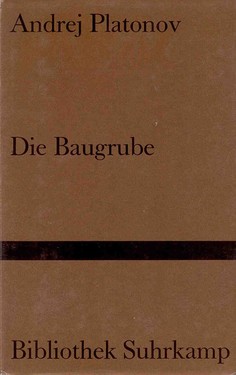
The German translation by Aggy Jais, “Die Baugrube,” which was published in the Suhrkamp Bibliothek series in 1971, says that Platonov wrote The Foundation Pit between December 1929 and April 1930. The author’s spokesman, Voshchev, is a dangerous person, dangerous to himself and dangerous to the State, for he will never allow himself to be happy and quiet: he thinks too much. “Thus conscience does make cowards of us all” – Hamlet’s concern might be Voshchev’s motto.
At the age of thirty, Voshchev is dismissed from the factory where he has given much time during working hours to pondering and wondering at the meaning of life, man and the universe, thus neglecting his duties toward the young proletarian society. He joins another community digging out what is to be the foundation pit of a big house, the future splendid home of the entire town’s proletarian population. Whether they have had access to education or not, all the characters in Platonov’s tale are “wanderers” seeking truth and happiness in a new, still troubled and poor society. The question raised is how they will all bear up under the process of collectivization.
The adults in Platonov’s book, with few exceptions, seem to share the feeling that a better world will be attained only in the coming generation, and the images of adolescents and children embody their faith or at least their hope that there will be happiness one day. More than once, Platonov shows one of his lonely masculine heroes looking with great feeling at girls or young women as at a vision of coming riches and beauty. The whole group of isolated men working at the foundation pit adopts a little orphan girl, who will be one of the first happy inhabitants of the house they are going to build. The girl dies, however, and those who loved her dearly bury her with utmost care. On that note, Platonov’s story concludes.
The book may be read and interpreted on different levels: it is a story of the difficult and rude beginnings of Soviet Russia; it contains a critical view of the harmfulness or absurdity of automatic behavior and bureaucracy; and it bears testimony of human longing for truth, love and beauty. Thus it transcends the limits of the historical situation; and although it partakes intimately and profoundly of the great traditional Russian literature, it transmits a universal view of mankind. Platonov shows himself to be a gifted, many-sided writer. He excels in sober but delightfully lyrical description, in “the grey mood of tenderness,” in reflective analysis and in witty satire. His satire is neither cruel nor tinted with scorn, however, for Platonov always dwells with sympathy and compassion on his fellow-beings and the world.
Rosemarie Kieffer
Lyceé Robert-Schuman, Luxembourg
"