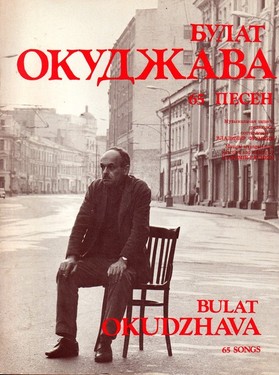
To experience the passionate response of the educated Soviet public to the song poems of Bulat Okudzhava was to plunge several layers beneath the usual level at which Western specialists perceive the Soviet Union. For fifteen years beginning in the late 1950s, Okudzhava’s performances gripped an entire generation. The intensity of those sessions beggared such scholarly categories as “de-Stalinization” or “the death of Socialist Realism.” As Vladimir Frumkin explains in his modest but insightful introduction to this collection of 106 songs, Okudzhava’s great contribution was more personal than directly political. He helped Russians rediscover sincerity: sincerity about one’s self, one’s city, about love, about things small and large. His songs provided the intelligentsia with models of honest living.
The means by which Okudzhava achieved these ends are deceptively simple. Frumkin correctly notes the absence in his verse of all formal pyrotechnics. His melodies are simple to the point of naiveté, and if his rhythms offer occasional surprises, his chordal structures and choice of key signatures make Joan Baez look like Schoenberg. Yet it works. It succeeds because Okudzhava sang with conviction and in a voice utterly lacking in the pretentious timbre and intonation of official culture.
This volume does not pretend to be a study of Okudzhava’s art. But it does present authoritative transcriptions of the texts and melodies of scores of famous and little-known songs, and also includes revealing quotations from the poet, a bibliography of secondary works on Okudzhava, and interesting documentary photographs. One might wish that data on the date and circumstances of composition of each song had been provided, but this, too, is beyond the editor’s intention: simply to make available a corpus of songs through which a generation in Russia overcame the psychological legacy of Stalin’s time.
By concentrating on Okudzhava, Frumkin chronicles a central – the central – figure in the restoration of the sung word in the 1960s. Any comprehensive study of this development as a whole, however, would have to take into account other individuals and movements as well, notably Alexander Galich and Vladimir Vysotskii, who are still being mourned, and also the many singers of labor-camp songs and the countless unofficial rock lyricists whose appearance after 1965 marked the full revival of the sung word in the USSR. But no such study can be carried out until these other bards, too, find their Koechel, Deutsch, or Frumkin to bring together the basic materials. Frumkin has made a most welcome start in this direction, and both he and his publisher, Ardis, are to be congratulated for their pioneering foray into an area of immense promise.
S. Frederick Star
Tulane University
"