The Individual and the Collective
A note of mingled anguish, restlessness, and affirmation pervades most of the best Russian poetry since 1955. This post-Stalinist mood is well expressed by Evgeny Evtushenko in his lines, "Let us be extremely outspoken, and tell the truth concerning ourselves." The same is also true of certain Soviet writers of fiction, memoirs, and reportage. These prose writers, older men like Ehrenburg and Paustovsky, or younger men like Nekrasov, Aksionov and Solzhenitzyn, are now attempting to enlarge the frontiers of Soviet reality, which had become frozen by the too rigid application of doctrinal "socialist realism." These writers, though perhaps less anguished than the poets, are striving with greater irony and command of bare fact to fill in the gaps with suppressed detail. They are, in fact, trying to restore to Russian realism some of the vigor and reputation it had once enjoyed. But their task is not merely an aesthetic one; it has also a significant ethical bearing. They are rediscovering the concept of "truth," which had for decades been sacrificed to political expediency and party control. That some very real divergence of opinion has indeed occurred is, perhaps, best exemplified by the very recent measures (December 1962-May 1963) instigated by Mr. Khrushchev and his idealogical henchman, Mr. Ilyichev, to reassert party control over writers and artists of all sorts.
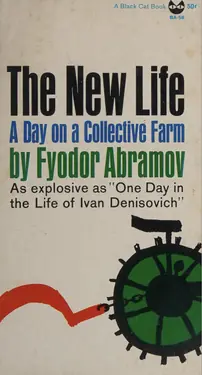
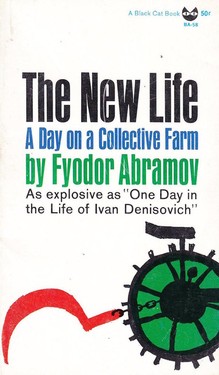
Fyodor Abramov's The New Life: A Day On A Collective Farm, first published in the January issue of the Leningrad magazine, Neva, is a work in the new revelatory mood. It is a work of refreshing, almost naive but effective realism directed toward the hitherto elusive facts of Soviet life - in this case, the Russian countryside of the collective farm. Abramov touches upon that very sensitive area of Soviet agriculture with which Mr. Khrushchev is so vitally concerned and of which he usually speaks in terms of statistics, as he has recently done to an Italian journalist: "It is not clear to what agricultural crisis you refer." (See the New York Times, April 22, 1963.)
Abramov, on the contrary, deals with human beings, with the peasants, kolhoz workers, and the party "managers" responsible for implementing the collective policy. Abramov has selected the simplest of themes: a kolhoz chairman, Anany Yegorovich - the hero with an almost innocent eye - who is faced with both the ruin of his crops and the uncooperative attitude of the kolhoz workers who, lacking sufficient collective incentive or gain and no longer moved by propaganda, are more concerned with the possibilities of private endeavor. This simple but fundamental issue reveals all the complexities of a system which appears inhuman and wasteful in practice.
Written with quiet humor, keen observation, and a sort of understatement, Abramov's The New Life is an unexpectedly sensational account of both rural Russia and the Soviet collective system superimposed upon it. The facts as presented by Abramov show not only a strong upsurge of individualism among the rural population, but also some uncertainty on the part of "the authorities." The realities of Russian life as depicted in The New Life are startling and give food for thought. In this sense, Abramov's work is one of the most vivid and telling accounts of "ordinary" Soviet life I have come across. In addition to the wealth of information it provides about the Russian countryside, The New Life also offers us an extraordinary gallery of Russian country characters, who are all determined to survive through thick and thin. The chairman Anany Yegorovich, though imbued with a sort of post-Stalin humanism, which makes him reflect on the "crimes" of the past, has moments of almost regretting the 1930's when harsher measures could be applied to a recalcitrant population.
Thus: "Anany Yegorovich bit his lower lip in indecision. Should he try and catch up with them, knock over those damn baskets, seize the women by the scruff of their necks and push them straight into the fields? Yes, some eight years ago he would certainly have done so. There were models to imitate in both life and literature. One of the books, for example, related how one kolhoz chairman used to catch uncooperative kolhoz workers outside the village, while another chairman had acted even more drastically: he'd break into a cottage in the morning and douse the stove with water. In the region these books were used for moral rearmament. "That's how you should work, the district committee secretary would lecture the kolhoz chairmen, quoting literary examples to illustrate every case. You clumsy louts, you can't even manage women.' "Yes, some eight years ago Anany Yegorovich would have put fear into these mushroompickers. But now..."