Information
Thomas H. Hoisington. Review of Collected Works by Andrei Platonov
Томас Хойсингтон. Рец. на Collected Works Андрея Платонова
Text
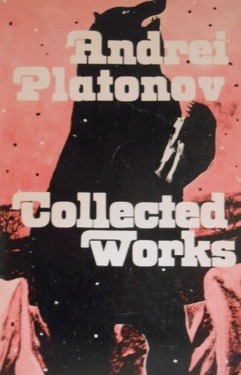
“Selected Works” would be a better title for this volume. Included are ten short stories, a three-act play The Barrel Organ, and“The Foundation Pit,” a novella. Joseph Brodsky’s brief and imaginative introduction and the novella, along with the original Russian texts, were actually published earlier by Ardis in a separate, bilingual edition (see B<ooks> A<broad> 49:2, p. 351). Five of the ten stories – “The Potudan River,” “Homecoming,” “Light of Life,” “The Third Son” and “Fro” – have appeared already in English translation, four of them twice. The Barrel Organ and “Epifan Locks,” “The Cow,” “The City of Gradov” and “Makar the Doubtful” are translated for the first time.
Of these newly translated works, The Barrel Organ is the most curious. Not included in any of the standard Soviet editions of Platonov’s works, its cast-iron robot is reminiscent of Mayakovsky; the revived dead man recalls Witkiewicz. While the concern with bureaucracy and opportunism is characteristic of the times, the strong yet naive Myud is a type of character only Platonov could create. The play has a surrealistic aura (to use Brodsky’s term for “The Foundation Pit”), though its humor, achieved by bringing together seemingly disconnected events and phenomena, foreshadows absurdist dramas of writers such as Mrozek.
The stories, though varied in content and subject, all seem to revolve around loss or false gain. The cow, in the story by that title, commits suicide when deprived of its offspring. In provincial Gradov the commune foreman has built a perpetual motion machine that runs on moist sand; the words of the new social and political order underscore the mediocrity of Shmakov, a bureaucrat from the outside world. Makar is more dubious than doubtful. The road to the proletariat leads him to a flophouse. To him new construction does not represent the building of socialism; he has never seen the Communist Party, and he finds he is qualified for work as a state official merely because of his simple origins.
“Epifan Locks” and “Takyr” are the most fascinating stories in the collection. Peter and Great’s Russia is the setting of the first, about an English engineer who tries, fails and then is fatally mutilated for failing to construct an ambitious inland waterway. “Takyr” is a lyrical description of a mother and child who first are captives in desolate lands, later deserted. They are no less symbolic than the ancient plane tree which has ingested stones or the ruined tower with its inhabitant, the one-time Viennese optician.
The translators, five in all, have done extremely good work given Platonov’s linguistic complexity. Thomas Whitney tries too hard at times to reproduce the colloquial quality of “The Foundation Pit,” and when he does, the English becomes distorted. For unknown reasons Alexey Kiselev in “The Cow” chose to render sostav (train) as “echelon” and teležka (truck) as “small cart,” terms not defined in either Webster’s or the OED as ones which pertain to railways.
Thomas H. Hoisington
University of Illinois