Text
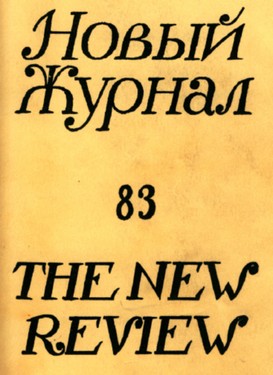
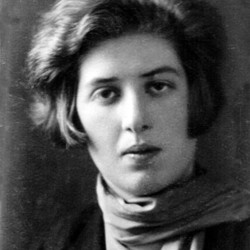
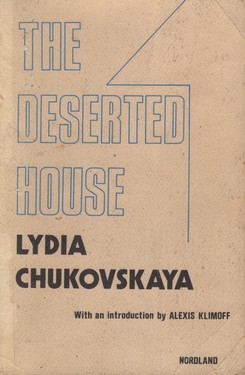
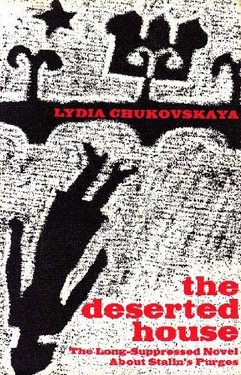
Lydia Chukovskaia’s short novel, written in 1939-40 and first published in 1966, appears here in a reprint of Aline B. Werth’s excellent 1967 translation, which was based, unfortunately, on the Paris book version (Opustelyi dom) rather than on the authentic journal version (Sof’ia Petrovna) of Novyi zhurnal (nos. 83 and 84). The novel describes the mass arrests of 1937-38 from the viewpoint of an “average” woman whose son, a loyal Young Communist, is arrested and sentenced to ten years in a prison camp. It may serve as a proper illustration to Robert Conquest’s The Great Terror. The Western reader should not duplicate the practice of Soviet ideologues who quote Upton Sinclair’s The Jungle as evidence of the evil of capitalism. The Deserted House deals with the truth of the past. The truth of the present is different, better in some ways (no mass arrests), worse in others (no idealistic young people who sincerely believe in the bright future of communism).
Alexis Klimoff’s substantial introduction places Chukovskaia’s novel into proper literary context. Klimoff presents a useful historical survey of the developments which have caused Russian literature, regardless of its political orientation, to claim and receive credit for supreme social relevance, not only as a mirror, but even as an oracle and an agent of a nation’s destiny—with appropriate rewards and perils. Klimoff also sketches Chukovskaia’s position in this scheme of things. She is an objective writer whose sense of being called to witness is engaged by the condition of the world she faces. Telling the truth about it also means protesting against it. Whatever aesthetic values her work may have are derived from the truth which it carries. Interestingly, this position was traditionally associated with the radical wing of Russian literature, while the conservative position was that the aesthetic value of a work of art was primary, implying a guarantee of its truthfulness.