Information
Vladimir Frumkin and Mary Reichert. Review of Songs and Poems by Alexander Galich
Владимир Фрумкин, Мэри Райхерт. Рец. на Songs and Poems Александра Галича
Text
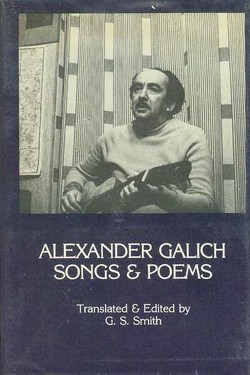
Alexander Galich: Songs and Poems is a bold attempt to convey to an English-speaking audience the fundamental meanings and feelings carried by the poetry of Alexander Galich and, at the same time, to provide “singable” English translations of Galich’s work. The sensitivity and obvious respect with which Smith approaches, on the one hand, the subject of Galich’s life and art, and on the other, the task of translating this poet’s unique verse, make for a commendable book.
Gerald Smith has established himself as a leading expert on Soviet guitar poetry. This is first large-scale work dealing with this fascinating aspect of modern Russian culture. (His Songs for Seven Strings, an overview of the guitar poetry movement as a whole, has just appeared.) Despite the widespread interest which the Russian poet-singers seem to have aroused in the West, there has been surprisingly little written about them in English, and only a very small portion of their verse has been made available to English-speaking audiences. Smith’s contribution helps to remedy this situation.
The book opens with a forty-page biography of Galich. Smith displays an excellent ability to sense the essential features of a world which, to most non-Russians, remains clouded in mystery – the realm of Soviet reality and, specifically, of the contemporary Russian intelligentsia. The central theme of Smith’s introduction is the (on the surface) abrupt transformation of a successful member of the Soviet artistic elite into a man who knowingly took a path which ultimately led to the undermining of his comfortable position in Soviet society. Before reaching the logical conclusion of this chosen path, however, Alexander Galich for some years lived a kind of double life, functioning as a state-sponsored scriptwriter and playwright, while condemning in his underground songs the hypocrisy and inhumanity of his society and of the literary circle to which he belonged. He felt acutely the discrepancies within his own personality and life; in the bitter reproach with which he so often fueled his poetry, he spared himself perhaps least of all. In this sharp sense of personal complicity in the crimes of his age, Smith sees the key to the uniqueness and forcefulness of Alexander Galich’s work.
This interpretation of the source of Galich’s creative energy as a poet-singer is presented in a penetrating and convincing manner. However, not all of Smith’s theorizing regarding the inner world of the poet is quite so well-argued. His conclusion that the decline in Galich’s artistic potency once he reached the West was the direct result of the attainment of some kind of spiritual peace is a highly dubious proposition. Where is the evidence that Galich actually did find spiritual peace toward the end of his life? Is it really likely that so complex a personality, one suffering the depth of anguish which Smith describes, could by “becoming a writer whose outcast status was consistent with his dissident attitudes,” (p. 51) resolve all of his internal contradictions? Furthermore, could his loss of some “vital spark” not be attributed at least partially to the loss of the particular atmosphere in which Galich’s best songs were created and performed, an atmosphere of risk, in which he constantly interacted with highly perceptive audience members who themselves were experiencing a sense of flying in the face of standard hypocrisy and airing the truth at last?
The major part of Alexander Galich: Songs and Poems is, to be sure, devoted to translations of fifty-nine of Galich’s poem-songs. Given the complexity of some of the references and images and the degree to which this poetry is culture-specific, the translations are impressive. They are further evidence of Smith’s understanding of Galich as a poet, of this particular genre, of the style of language, and of the context in which it was written. In some cases, to be sure, Smith’s determined attempt to preserve the original meter of the poems and thus make them singable in English has resulted in artificial constructions, perhaps even in a partial sacrifice of meanings and feelings. Smith states that “singability <…> has been a powerful influence on the choice of words” and that “[w]ithin this constraint, the intention has of course been to transmit as much as possible of the meanings of the originals as the resources of the translator’s wit will allow” (p. 55). Is it really worth introducing such a “constraint” in to the translation process when this admittedly may be detrimental to the task of conveying meaning? Since it is doubtful that these poems actually will be sung in English, the goal which Smith has set for himself is somewhat quixotic.
It should yet be stressed that Smith has been successful overall in conveying the essence of Galich’s mood and message. The book is a source of insight into the life and art of a remarkable personality. Smith has tackled a difficult undertaking with great spirit and expertise, and the results are a noteworthy contribution to the study of modern Soviet culture.
Vladimir Frumkin, Mary Reichert
Oberlin College