Editorial Note
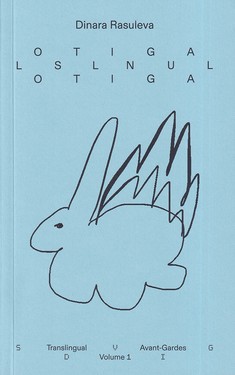
Dinara Rasuleva - or Dinara Rasul(eva), as she calls herself in the manuscript of Lostlingual, bracketing the suffix imposed on her last name by the Russian language - is a poet who emigrated to Berlin from the Russian Federation in 2014. She became a Russian-language poet in Berlin, taking part in the poetry readings at the Panda Theater, where she was noticed for her wordplay and performance energy. After Russia openly invaded Ukraine in 2022, Rasuleva began to experiment with the language of her childhood, Tatar, whose development had been stunted by Russian schooling and which suffered further attrition after her displacements and the deaths of her parents. Her return to Tatar resulted in Lostlingual, a collection of poems in her four languages-Tatar, Russian, German, and English-that overlap, cross, and fill in each other's gaps. The book documents her re-learning her first language, which comes back eroded, imperfect, often incorrect, and rich with associations of childhood.
Rasuleva's poetry is translingual not only in the fact that all her four languages can appear in a single poem. Translingual poetry is the poetry of linguistic relativity, in which different languages do not translate each other but rather say different things, as is the case with Lostlingual. Translation is impeded by the meaningfulness of language choice. Rasuleva's self-translations gesture at incompleteness. When I asked the author whether she wanted to render more of her lines in English, so that the reader has an easier time with her book, she responded that "my intention is not to translate everything to one language", and explained, "if some parts will be unclear and missing that's only усиливает ощущение потери растерянности которое я хочу передать" (intensifies the feeling of loss and confusion which I want to convey). Her attitude to translation is also anti-hierarchal and political, in that sometimes she translates into Tatar, not a language the majority of her readers would know, in protest against real-world power asymmetries. Sometimes, the translation and the original slide into one another until it is not certain which is which. She decided during the editing process that it is the original and not the translation which quotes a whole stanza from a poem by a German Romantic, whose East Prussian homeland has also been annexed by Russia. Indeed, even though Lostlingual is not especially intended for a German audience, much of the German in the book has remained in German, at the poet's demand.
As can be seen, the poems of this book address metalinguistic themes, such as what it means and how it feels to be speaking this language as opposed to that language. Hence the author grants herself freedom from linguistic correctness, finding poetic significance in the misremembering of Tatar words and in the errors she makes in her native tongue. After all, the difficulties she experiences with the language of her childhood are not only psychologically but also historically significant. Each error, each forgetting, each pause points to some scar left by Russian colonization. The trauma of history is what we bear within, and it brands our deepest, most intimate structures. For Rasuleva, to reveal our linguistic dysfluencies is to deny colonialist mystification and, instead, to display the workings of history on the present.
As a translingual poet, Rasuleva devotes a lot of attention to linguistic materiality. Emphasizing how words sound and how they connect to one another is the logical result of toggling between languages. In selecting words by sound before sense, she evokes the uncertainty of language learners in encountering not entirely familiar expressions. "Qara", the second poem in Lostlingual is paradigmatic as far as such punning is concerned, and also offers us a model of how a poem in one language - here, Tatar - can still remain a translingual poem. "Qara" starts as a pun on the imperative of the verb to look (qara) and the adjective for black (gara). Then "qara le qara" generates "qara le qaynar" (look at the hot), which by phonetic associations produces "qar" (snow), "qan" (blood), and "qap-qara" (pitch-black). Crucially, the next pun violates linguistic borders, crossing over into Russian, in that "qap", an intensifier, generates the sound of dripping water in Russian (kap, kap, kap), with the subsequent association being semantic than material - the dripping takes place "from the wounds". The argument of the poem - its comparison of speaking an attrited first language with bleeding-emerges from the sound play, which also motivates the leaps into German ("qan" to "kann") and Russian ("sezsez" to "es sez"). It should be added that the author's original translation of the first line was also a pun, made in the combination of German and English that in Berlin is called Denglisch. She translated "qara le qara" as "blick mal, black" (take a look, black).
This was an extremely hard book to edit and editing it raised many questions. Printing entails standardization. Printed language aims at consistency in order to facilitate reading, but showing one's linguistic dysfluencies- whether in the half-forgotten language of childhood, or in the English informally learned by somebody who has never lived in an English-speaking country - does nothing for consistency. How does one set a linguistically nonstandard utterance in print? How does one set a direct — rather than third-person-linguistically nonstandard utterance in print, knowing it to be nonstandard? Should the editor correct the translingual poet, who is making a poetics out of linguistic incompleteness? And then there are the power relations among languages. Should somebody writing in second-language English about Tatars adopting Russian under colonial pressure be made to adopt correct literary English, a language far more effective in its global spread than Russian, and one whose subjugation and displacement of other languages is ignored by two groups of beneficiaries: English native speakers and peoples liberating themselves from more crudely colonial languages, which are equipped with more authoritarian, top-down linguistic ideologies?
The manuscript as received bore signs of linguistic difficulty. For example, there are several ways of writing Tatar, which may or may not carry different politics on their sleeve. At least two or perhaps three were present in the original. English adjectives for nations and languages were sometimes in caps and sometimes in lower-case. The latter is generally regarded as a language-learning mistake but it may also be a political stance (e.g., today Ukrainians currently lower-case the word "Russian" as a feel-good gesture against Russian colonialism). More generally, linguistic incompleteness and the inability to perform to standards are crucial themes of the book. The display of the lack of full competence in any language lies — or "lays", as the author insisted on spelling despite my query - at the heart of its translingual message. I was tempted to regard all deviation from standard usage as fodder for analysis. However, much of the variance was not deliberate but random. More importantly, the manuscripts of native speakers of English also exhibit signs of linguistic difficulty, but of course they are edited and standardized before seeing print, because otherwise they would lose in authority. Consequently, to not standardize Lostlingual at all would be a disservice, since symptoms of imperfect competence may put off readers and prevent them from taking the work seriously. I therefore standardized. I standardized as little as I thought advisable, but I did think it advisable quite often. I would have preferred to err on the side of the nonstandard, but I also wished to refrain from fetishizing the original and exoticizing the author. I checked with the author for approval but realized that the very fact of asking a question in such an exchange makes the question a leading one. I am sure that whatever I did is wrong from one point of view or another.
Eugene Ostashevsky
February 2025
Berlin