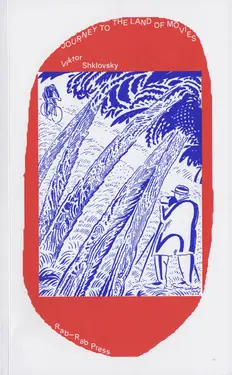
Viktor Borisovich Shklovsky was a small, bald man, yet remarkably strong. A revolutionary, one of the founders of the Society for the Study of Poetic Language (OPOYAZ), and of the formal method in literary theory. A friend of Vladimir Mayakovsky, and an ironic, Sterneian voice of his era (in fact, in Russian, such people are called: chelovek-epokha). A chronicler of his times in the genre of self-portrait. The father of sentimental editing.
To film — whose importance he was one of the first to recognise (he authored a pioneering book about Chaplin, published as early as 1923), not only in his homeland but across other countries in Europe—he dedicated 60 years of his life and work. Not only as a theorist or critic, but also as a practitioner: a screenwriter, and occasionally even an actor. He claimed to have come to cinema for the money, but Viktor Borisovich was a very cunning man, who once said that “one’s own biography should be broken over the knee”. (Just look at his smile in the photos.)
Shklovsky wrote Journey to the Land of Movies (1926) after returning from his Berlin emigration in 1923. He had immediately immersed himself in the filmmaking process of the young Soviet state, which by then had already produced avant-garde masterpieces in the “seventh art” (Eisenstein, Vertov, Pudovkin), as well as the highly “eccentric” works of the FEKS group (The Extraordinary Adventures of Mr West in the Land of the Bolsheviks, 1924—the film mentioned in this book).
To lift the curtain just slightly on the mystery that is inherent to cinema—to bring this young art closer to its audience—several magazines were published, dedicated entirely to movies. These covered topics such as the lives of famous actors, the mechanisms and functions of the film camera (or projector), the structure of a film set, and so on.
All of these curiosities are addressed in Journey to the Land of Movies, but this ingenious children’s book simultaneously represents an artistic and theoretical synthesis of Shklovsky’s common motifs, ideas, and actions. On the one hand, it’s a story about travel — a theme of almost sacred significance for Shklovsky, who so admired Laurence Sterne’s Sentimental Journey that he named one of his own best books the same. On the other hand, it’s a formalist work in praxis — because it shows us the way something is made.
Which is to say: in this book, Shklovsky—through the eyes of the Soviet boy Kolya Petrov on his journey through the United States—essentially creates a children’s manual of defamiliarisation, while also presenting a Marxist critique of the capitalist mode of production in American society, using as his example the dream factory of Hollywood.
It’s difficult to imagine a more perfect setting for such a thing. And besides, you could meet Charlie Chaplin, in person, right there on the street, naturally in the middle of shooting his new film.
Adam Randelović