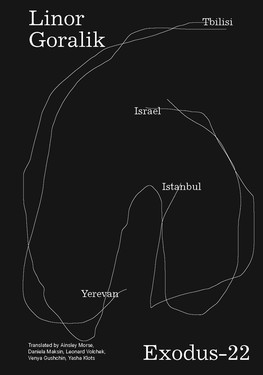
Недавно в издательстве Tamizdat Project вышла книга Линор Горалик “Исход-22 / Exodus 22” о эмиграции, потере и катастрофе. Это мозаика голосов и свидетельств людей, вынужденных покинуть Россию после начала войны. Специально для слов_вне_себя рецензию на неё написала поэт и филолог Полина Барскова.
Мы знаем, где прошла линия разлома.
Но линии? Помимо одной катастрофической черты, разломившей современную историю России на до и после, возникли миллионы других линий, разломились миллионы жизней. Кто ответит за все эти жизни, и кто расскажет их?
Книга Линор Горалик “Исход” вышла в издательстве Tamizdat Project, которое выбрало себе девизом известную фразу: “В зависимости от читателей, книги имеют свою судьбу”. Примечательно, что в этом древнем меме подчёркивается зависимость, власть читателя над книгой, решающая способность разглядеть, принять и понять.
Как изменились мы, читатели этой книги, за три года с тех пор, как она была весьма отважно задумана и написана в 2022 году? Расстояние во времени между моментом создания и моментом прочтения производит особый эффект сегодня: в первую очередь перед нами машина времени, исторический артефакт, свидетельство эпохи, когда мы страшились и надеялись — но ещё не так, как сейчас, острее и внимательнее. Читательские реакции покажут, насколько сейчас эта книга придётся ко времени. Мне кажется, по своей разнообразной и гибкой жанровой природе “Исход” — это именно то, что нам сейчас нужно, что мы сейчас можем быть в состоянии воспринять, как читательское сообщество в состоянии кризиса (kritein — древнегреч. разделять, судить). Это вообще крайне увлекательная и сложная тема: как национальная катастрофа превращается в книги — сначала в очерки, дневники и стихи, затем, медленно и постепенно, в аналитические конструкции типа “Войны и Мира” и “Хаджи-Мурата,” “Жизни и судьбы” и “Генерала и его армии”.
Горалик — очень любопытный свидетель и документалист. Она хотела бы быть бесстрастной, однако она полна страстей. В первую же очередь она поэт, то есть мастер во всем ищущий и всему придающий форму, конструкцию. Этот текст жанрово многогранен: так, он может казаться читающему учебником по релокации в её начальных стадиях с более или менее ожидаемыми темами — столкновения и контакты с местными жителями, тоска по оставленному миру и городу, попытки заработать, попытки ассимилироваться, отношение к путинскому режиму, отношение к России и русскому языку, отношение к оставшимся и к своим отношениям к оставшимся. Следуя по городам (Тбилиси—Ереван—Стамбул—Тель-Авив), куда прибивало вырвавшихся из тонущей в путинской войне России, Линор превращается в свидетеля, и слушателя, и собеседника — в то самое стендалевское зеркало, которое стоит при дороге.
Сразу скажу, при первом приближении эта книга напомнила мне другую, как водится, очень важную для меня, книгу — “Слухи в блокадном Ленинграде” Владимира Пянкевича. Выгрызая, вылавливая свои сведения из дневников, писем и воспоминаний, замечательный петербургский блокадовед Пянкевич нацелился восстановить поток речи ужаса, которым был пропитан блокадный Ленинград. Специфика жизни в советском осаждённом городе заключалась в том, что все прислушивались к голосу власти. И дело не только в мифологическом восприятии Берггольц — дневники и в самом деле полны интерпретаций выступлений Жданова и Попкова, их яростно слушали и им совершенно не верили. При этом было необходимо формировать свое понимание происходящего, чтобы выжить. Город жил слухами — города всегда живут слухами, особенно в моменты катастроф, когда нужно принимать неожиданные сложнейшие решения и шагать вперед в то, что кажется неизвестностью и хаосом. Катастрофа — это неизвестность и неспособность понимать, что есть и что будет.
Именно в эту массу реакций на катастрофическую неизвестность отваживается вступать Линор Горалик. Собственно, это один из самых острых вопросов русскоязычной литературы сегодня — кто попадет в историю с пером (магнитофоном, компьютером) в руках и как будет этой историей распоряжаться.
Нам известно, что у Горалик есть склонность к собиранию и препарированию историй, настроений и мнений и превращению этого потока во флэш и фикшн. Я воспринимаю это как человек, только что предавшийся работе по искусству стекла: Горалик собирает и организует потоки (реакций и эмоций), и в этих потоках мерцают, поблёскивают моменты отчаяния, надежды — и всегда остроумия. Потому что одной из своих жанровых граней эта книга — именно заметки, как те, через которые нам Вяземского преподнесла Лидия Гинзбург (написав о нем, откомментировав и опубликовав), позже преобразив их уже в своё собственное письмо. В циклах флэшфикшн Линор “говорит”, на мой взгляд, новая версия таких заметок и анекдотов, именно в смысле Вяземского и Гинзбург, — фрагменты личного времени, вырезанные из потока общей истории авторским стеклорезом:
Терапевтка Н. рассказывает, что её клиентка объясняет, будто смотрит на то, как люди продолжают делать покупки, отмечать праздники, сидеть в кафе, — и чувствует, что окружающие гуляют свадьбу, а за столом сидит мёртвая припудренная невеста. И что ты присутствуешь на этой свадьбе и пытаешься понять, что происходит, но это выше твоего понимания и выше твоих сил.
Мы понимаем, что то, о чём пишет (вернее, что, выбирает слышать и собирать) Линор, — это трагедия, но она обращает внимание именно на хор, что особенно редко встречается — на его отдельных участников.
В самом прямом смысле перед нами то, что кажется коллажем дневников:
Сквозная тема в разговорах: возвращение en massе приватных дневников. Потому что сегодня очень много такого, что раньше шло в соцсети, а теперь это неприлично писать, высказывать, выкладывать, потому что всё должно быть посвящено войне. Но привычка фиксировать моменты личной жизни сохранилась. Дай бог, чтобы мы действительно в какой-то момент получили много примеров автобиографического письма из этого периода.
Такое делалось раньше — тут нельзя не упомянуть великих беларусов Адамовича и Алексиевич с их гибридами дневников и oral history, однако очевидно, что Горалик развивает самый любопытный (и болезненный) вопрос в обращении с этими текстами — в том, как это сделано и обработано, каков метод сборки. Центральным эмоциональным узором здесь представляется сочетание трагического и повседневного, трагического и смешного (в диапазоне смеха — от умилительного до гротескного и абсурдного).
И в этом у Горалик есть важная предшественница, описавшая исход 1920-х: в своих “Воспоминаниях” Тэффи постоянно “путает” регистры и этим держит внимание читателя: она ведет своих покидающих Россию персонажей сквозь утраты и унижения, утешая, лаская их смехом и сочувствием, помня о маленьких вещах бытия, которые оказываются самыми важными в беде. Острое сочетание трагического и смешного, глобального и интимного — это урок и след Тэффи, который я вижу у Горалик.
Н. очень любит блокнотики. Купила блокнотик, а блокнотик не радует: вдруг Путин действительно так пизданулся, что сбросит на нас всех ядерную бомбу, и я этим блокнотиком уже не воспользуюсь? Вместо радости — одно расстройство.
Перефразируя наблюдение Бродского о том, что в трагедии, в первую очередь, страдает хор, Горалик и есть защитник такого хора — хора отдельных и неудобных.
В каком-то смысле неудобство — это одна из главных для меня тем этого текста.
Неудобство катастрофы, неудобство оказавшихся в катастрофе, неудобства тысяч изогнувшихся, преломившихся жизней. Им неудобно, неудобны и они, внезапно без подготовки покинувшие свои рутины, пути, привычки и планы, выбросившие себя на чужие берега, под бременем своих несовершенств (как было сказано о Гамлете старшем). Линор категорически не отворачивается от этих несовершенств: и бегущие, и их новые соседи предстают на этих страницах очень человеческими, полными сомнений и тревог, — и над всеми нависает главный вопрос (на который сейчас нет ответа ни у Горалик, ни у кого из нас) и страшная тень. Книга заканчивается так:
Вся эта потерянность, растерянность эмигрантская, — говорит Н., — это все очень больно, но на фоне Мариуполя совершенно неуместно.
Recently, the publishing house Tamizdat project released a book about emigration, loss, and catastrophe: Linor Goralik’s “Исход-22 / Exodus 22”. It is a mosaic of people’s voices and testimonies who were forced to leave Russia after the war began. Polina Barskova, a poet and philologist, wrote a review of Goralik’s book specifically for слов_вне_себя.
We know where the fault line passed.
But the lines? Despite the singular catastrophic streak that broke modern Russian history into a before and after, a million other lines appeared, a million lives broken. Who is going to answer for all these lives, and who will tell their stories?
Linor Goralik’s book “Exodus” was released by the Tamizdat Project publishing house, which chose a famous phrase as its motto: “Depending on the readers, books have their destiny”. It is remarkable that in this ancient meme, dependence is underlined: the reader's power over the book, the decisive capability to discern, accept, and understand.
How did we, the readers of this book, change in the three years from 2022, when it was quite bravely conceived and written? Today’s temporal distance between the moment of creation and the moment of reading produces a special effect: first, before us is a time machine, a historical artefact, a testimony to an epoch when, unlike today, we feared and hoped more sharply and attentively. Readers’ reactions will indicate how well this book fits the times. It seems to me that, due to its heterogeneous and fluid generic nature, “Exodus” is precisely what we need right now—what we are in a position to perceive, as a community of readers in a state of crisis (kritein - ancient Greek, to separate, to judge).
Overall, this is a highly fascinating and difficult theme: how a national catastrophe turns into books; first sketches, diaries, and poems, then, slowly and gradually, it morphs into analytical constructions like “War and Peace”, “Hadji Murat”, “Life and Fate”, “The General and his Army”.
Goralik is a very curious eyewitness and documentarian. She would like to be dispassionate, yet she is full of passions. First and foremost, she is a poet, thereby a master who seeks form in everything and gives everything a shape, a structure. This text has a multifaceted genre character: it can seem to the reader a textbook on relocation in its early stages with more or less expected themes: points of contact and confrontation with the local population, misery for the world and city left behind, attempts to earn, attempts to assimilate, attitudes toward Putin’s regime, attitudes toward Russia and the Russian language, attitudes toward those who decided to stay and our own stance on them. Following them through the cities (Tbilisi-Yerevan-Istanbul-Tel Aviv), where those who left arrived from Russia, drowning in Putin’s war, Linor becomes an eyewitness, a listener, and an interlocutor. She becomes that Stendhalian mirror standing by the roadside.
I’ll say straight away: on first approach, this book reminded me of another one, as usual, a very important book for me - “Rumors in Blockaded Leningrad” by Vladimir Piankevich1. The wonderful Petersburgian blockade specialist Pankievich aimed to recreate the stream of horror speech, completely saturating blockaded Leningrad by gnawing and fishing out his data from diaries, letters, and memoirs. The specifics of life in the besieged Soviet city consisted of everyone being attentive to the voice of power. And it is not only Berggolz’s mythological perception; the diaries are indeed full of interpretations of Zhdanov’s and Popkov’s performances, people avidly listened to them, and did not believe them. At the same time, it was necessary to form an understanding of what was happening to survive. The city lived by rumors. Cities always live by rumors, especially in moments of catastrophe, when the most unexpected and difficult decisions have to be made, marching into what appears to be the unknown and chaos. Catastrophe is the unknown, the inability to understand what is and what will be.
It is into this mass of reactions to catastrophic uncertainty that Linor Golarlik decides to venture. In fact, this is one of the sharpest questions in Russophone literature today: who will go down in history with a feather (a tape recorder, a computer) in their hands, and how will they manage this history?
We know that Goralik has a penchant for the gathering and preparing of histories, moods, and opinions, and then transforming this stream into flash and fiction. I perceive this as a person who has recently succumbed to working on glass art: Goralik collects and organizes streams (of reactions and emotions) that flicker and shimmer with moments of despair, hope, and always wit. Since one of this book’s genre boundaries is precisely the notes (zametki), like those through which Lidia Ginzburg presented us with Vyazemsky (having written, commented, and published on him), later transforming them into her own writing. In Linor’s flash fiction cycle “govorit”, in my opinion, is a new version of these notes and anecdotes. Namely, in the same sense as Vyazemsky and Ginzburg: the authorial glass cutter carves out fragments of personal time from the general stream of history:
N., a therapist, says that one of her clients explained to her that watching people go shopping, celebrate holidays, and sit at cafes made her feel as if these people were celebrating a wedding with a spiffed-up corpse bride presiding at the table. And that you were present at this wedding and struggling to understand what was going on, but it was beyond your understanding and beyond your strength. (p. 115 eng. side)
We understand that what Linor writes about (or rather, what Linor chooses to listen to and gather) is a tragedy, but it is the choir that she pays attention to, and what is noticed even more rarely, its separate participants.
We have in front of us a collage of diaries in the most straightforward sense.
“A recurring theme in conversations: the return en masse to keeping private diaries. Because so much of what people previously would have posted openly on social media is now considered inappropriate to write, express, or share publicly, because everything is supposed to be about the war. But the habit of capturing personal life moments has remained. God willing, we really will at some point receive a great many examples of autobiographical writing from this period.” (p. 124 eng. side)
This was done before; we have to mention the great Belarusians Adamovich and Aleskievich with their hybrid diaries and oral history. However, it is clear that Goralik develops the most curious (and painful) question in the treatment of these texts: how are these histories produced and processed, and what is the method of assembly? Here, the central emotional ornament is the combination of the tragic and the everyday, the tragic and the humorous (laughter ranges from the endearing to the grotesque and the absurd).
Goralik has a significant predecessor on this path, who described the exodus of the 1920s. In her “Memoirs”, Teffi constantly “mixes up” registers and uses this to keep the attention of the reader: she leads her emigre characters through loss and humiliation, consoling and caressing them with laughter and compassion, remembering the small things in existence, which become the most significant in times of trouble. A sharp combination of the tragic and the humorous, the global and the intimate; that is Teffi’s lesson and footprint, which I see in Goralik.
“N. really likes notebooks. She bought a notebook, but the notebooks didn’t make her happy: what if Putin really does go off the fucking deep end and blasts us all with atom bombs, and I won’t ever get a chance to use this notebook? Only distress in a place of joy.” (p. 78 eng. side)
Paraphrasing Brodsky’s observations that, in tragedy, the choir suffers first; Goralik is the defender of that choir, the choir of the separate and the inconvenient.
In some sense, inconvenience is one of this text’s central themes for me.
The inconvenience of the catastrophe, the inconvenience of those who found themselves in it, the inconvenience of thousands bent over, fractured lives. They are inconvenienced, and they are inconvenient, those who suddenly, without preparation, left their routines, paths, habits, plans, those who threw themselves on foreign shores, under the burden of their imperfections (as was said about Hamlet the senior). Linor does not turn away from these imperfections: both those running away, and their new neighbors appear on these pages as very human, full of doubts and anxieties. And above all, hangs the main question (to which neither Goralik nor any one of us has an answer to now) and an eerie shadow. The book ends as such:
“All this perplexity, this emigre bewilderment,” says N., “is very painful, but when you think of Mariupol, it feels completely inappropriate.” (p. 124 eng. side)
1Barskova, in Russian says “Слухи в Блокадном Ленинграде”. From what I understand, “Слухи в Блокадном Ленинграде” is an article released by Piankevich, and the book he wrote on the same topic is “Люди жили слухами: Неформальное коммуникативное пространство блокадного Ленинграда.”
(Translated by Nikolay Smirnov)